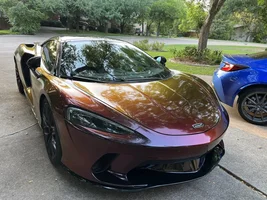
It’s so hard to get them in a photo, I can try tomorrow but the light needs to catch it perfectly.does anyone have photos of the location of the blisters on the rear quarters?
Follow along with the video below to see how to install our site as a web app on your home screen.
Note: This feature may not be available in some browsers.
It’s so hard to get them in a photo, I can try tomorrow but the light needs to catch it perfectly.does anyone have photos of the location of the blisters on the rear quarters?
No impact. Yes, rear bumper. Regardless of the underlying material, blistering paint appears to be a chronic problem. Given it's a multi-surface material problem. Deductive reasoning would lead me to conclude the root cause to be a painting process problem.@jeidmann
That looks like it is on the rear bumper (?) - so it's not the problem with the composite bilstering we are talking about in this post.
The bumper is molded plastic and also quite flexible. So either this has not been painted properly - it some impact has bend the plastic in, lifting the paint and the plastic would have sprung back into shape.
Apologies if I've got the location of this wrong. Any more details about this?
I see where you are coming from but your issue looks completely different to the composite bubbling issue. Neither show up well in photos online unfortunately. But if you were to see them both in the flesh you would probably come to a different conclusion, that different effects are at play here and it's not the same root cause.No impact. Yes, rear bumper. Regardless of the underlying material, blistering paint appears to be a chronic problem. Given it's a multi-surface material problem. Deductive reasoning would lead me to conclude the root cause to be a painting process problem.
I suspect you’re correct re the cause, but are you not worried that if you take a dremel to your doors, and the paint blisters anyway, that Lotus will void your paint warranty?I've had a good look at a door that was removed for replacement, because of blistering.
Whilst I know the locations of blistering has been shown to vary, and 'can' appear anywhere, by far the most common location seems to be centred around two horizontal rows of blisters that run along the door, a couple of inches below the window seal line, and the second row around two inches below that.
On the inside of the door, is a composite stiffener thats bonded to the inner surface. It has a joggle in it's form, that also plays the role of securing the bottom edge of the rubber window seal.
It's very clear on close inspection that the channel that this forms acts like a tiny gutter, in which water will 'sit'.
It's my opinion that any water that gets past the window seal and runs down the inside of the door skin, and sits in the gutter-like track, seeps into the unsealed inner door skin surface (osmosis style), likely reacts with chemicals within the laminate, and ultimately finds its way out, under the paint, forming blisters.
It appears, by the common dual rows of blisters, that this also happens at the lower edge of the stiffener, with water possibly just being held there via capillary action.
It certainly seems logical that two parallel runs of lingering moisture on the inner (unsealed) surface, presenting as blisters directly adjacent on the outer surface, suggests the blisters are related to the water present on the opposite side of the skin.
I plan to remove the window, regulator, seal etc, and go in with a dremel multifunction tool to grind out small gaps in the upper joggle to form drains, so no water is trapped, and also to seal the inner door skin with 2-pack paint, especially in the upper & lower 'water traps', in an attempt to stop this water ingress into the back face of the composite material. To clarify, I will seal the entire inner surface of the door skin, and address the gutter issue caused by the stiffener.
It will be important to not only remove the gutter trap element (a huge design fault IMHO), but also to ensure satisfactory sealing of the creavis where the stiffener is bonded to the door skin.
If I'm right about this, storing your car in a garage won't help, as the water that accumulates in that trap every time it rains, or you wash your car, is still sitting there, possibly for weeks, trying to find it's way into your door skin via the back (porous) door.... in fact, if you live in a hot, dry climate, there's much better chance of this moisture drying out before it does harm, if left outside in the sun, than indoors.
I don't use a hose, when washing my Emira, or any other method with copious amounts of water. I use a micro-fibre mitt with minimal soapy water (wrung out), wipe the car, wipe again with it rinsed, then leather it, using this method, no water runs down the inside of that door skin.... at least until i've done my mods.
I appreciate I shouldn't have to take this ridiculous precaution, but until I'm sure I've addressed what I believe to be the cause, it's what I will continue to do.
I've drawn a rubbish sketch showing a section of the door skin, and the stiffener, showing how the upper bit is deff a water trap, and the lower bit likely holds water by capillary.
The proper fix would of course be for Lotus (or Tejin) to completely seal the inner door skin surface (actually ALL inner skin surfaces of the composite panels) during manufacture 'BEFORE' bonding the stiffener in place.... Or to develop a less reactive composite laminate. .... But that won't be happening for my Emira, so I guess I'm on my own.
P.S. My Emira is now 2.5 years old, and so far, no blisters at all... but it never goes out the wet (unless I get caught out) and is garaged/pampered.
Someone did ask that back at post 200.I suspect you’re correct re the cause, but are you not worried that if you take a dremel to your doors, and the paint blisters anyway, that Lotus will void your paint warranty?
I was speaking to Lotus Silverstone about this. The warranty repairs are not done by the dealer but by an approved body shop. So the dealership makes nothing out of this - it just costs them time and effort to process the warranty for the customer and do the paperwork for Lotus. At least this was my recent experience; I do think this process has been changed by Lotus recently though as Silverstone are no longer using the local bodyshops they used for previous work.Also, of course, the dealer takes a profit from these warranty repairs, so they're really not likely to dob you in to lotus (and it could only be them that could trigger that). It's a shit show and they know it.
Maybe that's what they told you, but trust me, they do.The warranty repairs are not done by the dealer but by an approved body shop. So the dealership makes nothing out of this -
I don't think anyone is saying it's the same root cause. That's the whole point....it's not the same root cause.
I was told the same thing by my local dealer. To them handling paint warranty claims is just a monumental pain in the ass, and they see it as Lotus dumping responsibility on them. This dealer had new cars delivered fresh off the transporter from Hethel which already had paint bubbling. And the dealers are just as much in the dark as the rest of us about the root cause or whether the problem has ever been fully resolved in production. Complete shitshow.I was speaking to Lotus Silverstone about this. The warranty repairs are not done by the dealer but by an approved body shop. So the dealership makes nothing out of this - it just costs them time and effort to process the warranty for the customer and do the paperwork for Lotus.
I haven't heard of this stateside. If accurate, it really speaks to plant workers being at the point where some have just given up. Sad state, if accurate....This dealer had new cars delivered fresh off the transporter from Hethel which already had paint bubbling.